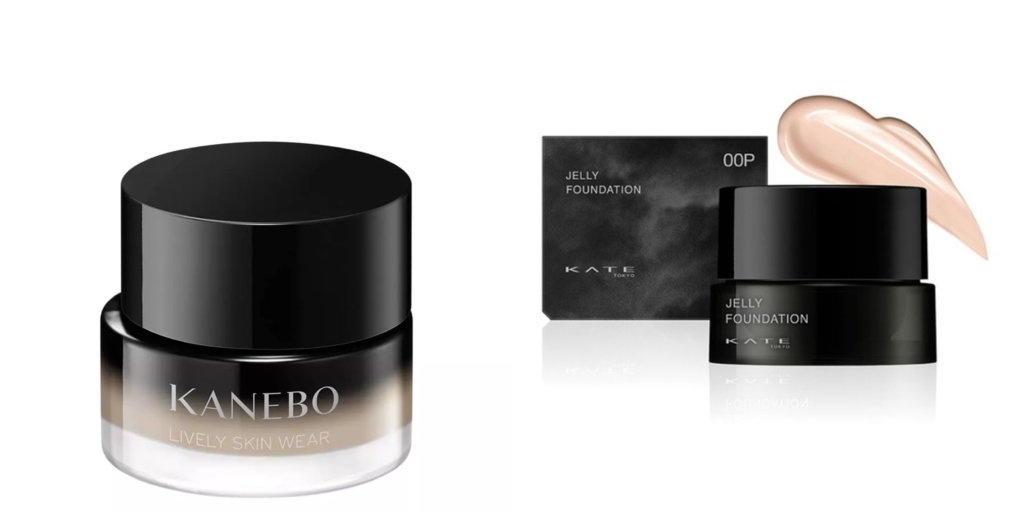
Hunting for a Kanebo foundation dupe that won’t cost $92? A viral infographic points to KATE Jelly Foundation at about $22, and the two brands share the same parent company.
KANEBO Lively Skin Wear II costs about $92 for 30g. KATE Jelly Foundation costs about $22 for 25g. That’s roughly 4.2x on sticker price.
The infographic says 4.9x, but the Hong Kong prices printed on it (HK$720 vs HK$169) work out to about 4.3x. Per gram, the gap is closer to 3.5x: about $3.07 per g for KANEBO against $0.88 per g for KATE.
Both formulas are made by Kanebo Cosmetics, a Kao Group company, so we expected overlap. We compared the CosDNA lists to see how much.
The Kao Group Connection
The infographic says both give a moisturizing, easy-to-blend bare-skin finish. It also says KATE’s coverage is solid, while KANEBO’s refined glow justifies its price.
Because both brands sit under Kao, they draw on the same ingredient toolbox. Shared parent companies often mean shared chemistry, but they don’t mean shared formulas. That’s what the INCI lists can tell us.
The At-a-Glance Comparison
| Product Name | Price (USD) & Volume | The Shared Kao Engine | The “Glow” Strategy (Lipids vs. Pigments) | UV Protection |
|---|---|---|---|---|
| KANEBO Lively Skin Wear II | High-shine silicones, Polysilicone-9 (#11), Maltitol | Lipids: Mineral Oil, Petrolatum, silicone fluids; Boron Nitride | SPF 4 PA+ | |
| KATE Jelly Foundation 01 | High-shine silicones, Polysilicone-9 (near the end), Maltitol | Pigments: Mica and Bismuth Oxychloride, plus esters and wax | SPF 30 PA++ |
The Shared “Jelly” DNA
The overlap is real. 16 of KANEBO’s 31 listed ingredients also appear in KATE’s list. That includes:
- Diphenylsiloxy Phenyl Trimethicone, a high-refractive-index silicone that gives a glossy sheen
- Methyl Trimethicone, Dimethicone and Trimethylsiloxysilicate, the silicone backbone that helps makeup spread and stay put
- Maltitol, Glycerin, Niacinamide and Sodium Hyaluronate, the humectant and skin-conditioning group
- Polysilicone-9, a silicone-based polymer
- Sorbitan Isostearate and Disodium Stearoyl Glutamate, the emulsifier pair, plus Aluminum Hydroxide and Sodium Chloride
That’s a lot of common ground. A few caveats apply, though.
Niacinamide and Sodium Hyaluronate sit near the bottom of both lists, so they’re finishing touches rather than the hydration engine. The real moisture comes from glycols, glycerin and the oils and esters.
Polysilicone-9 in KANEBO but near the end of KATE’s list, so the two don’t use it at the same level. We also can’t confirm from INCI alone that it’s a proprietary Kao polymer.
KANEBO’s Oil-and-Silicone Glow
KANEBO’s glow doesn’t come from sparkle. Its list is built on oils and silicones:
- Mineral Oil and Petrolatum are occlusive emollients that give a cushiony, melting feel
- Diphenylsiloxy Phenyl Trimethicone and Diphenyl Dimethicone add the glossy sheen
- Boron Nitride and Titanium Dioxide scatter light for a soft-focus finish
The skin-identical lipids, Phytosteryl Macadamiate and Branched Fatty Acid (C10-40) Cholesterol Esters (last), are at the bottom of the list. They’re likely present in small amounts, so don’t picture a barrier cream in a jar.
Mineral oil and petrolatum are inexpensive ingredients, so the $92 price reflects the brand, texture engineering and packaging more than a costly lipid blend.
Two other points: Alcohol and Fragrance is in the list. Both can bother reactive skin.
KATE’s Pearl-Pigment Glow
KATE builds its glow with a different toolkit.
It uses Mica and Bismuth Oxychloride for pearlescent shine. Kao markets the latter as “moonlight pearl,” so this isn’t a secret. It’s the point of the product.
It also adds esters and wax (Neopentyl Glycol Dicaprate, Diisostearyl Malate, Carnauba Wax) on top of the same silicone base. The result is a bouncy, glassy sheen with a higher-cover finish than KANEBO’s “invisible” coverage.
Bismuth Oxychloride can cause itching or irritation for some people, so patch test if your skin is reactive. KATE has no alcohol or fragrance in its list, but it does use Methylparaben alongside Phenoxyethanol as preservatives.
The UV gap is bigger than it looks. KATE carries Titanium Dioxide plus Octinoxate and is labeled SPF 30 PA++ (shade 04 is SPF 25). KANEBO lists Titanium Dioxide and Zinc Oxide but is labeled only SPF 4 PA+, and Kao advises applying sunscreen first. Check the label for your market’s version.
The Verdict: A Sibling, Not a Clone
KATE is a smart sibling to KANEBO, not an exact dupe. They share a lot of chemistry, but one glows from oils and the other from pearl.
Choose KANEBO ($92) if you have dry or mature skin and want a rich, oil-based cream that melts in and looks like skin. It also suits you if you already wear a separate sunscreen. It’s the more luxurious texture.
Choose KATE ($22) if you want a bouncy, hydrating cream with more coverage, a pearly glow and real SPF 30 for a quarter of the price. It’s the better daytime workhorse.
The smart-shopper move: KATE gets you most of the shared look for far less. Pay for KANEBO only if the richer, oilier feel matters to you.
Disclaimer: The information and ingredient analysis provided in this article are for educational and informational purposes only. Everyone’s skin type and condition are different; readers should carefully assess their own individual needs and conduct a patch test before purchasing or using any new skincare. Every product has its unique formulation and characteristics. For specific product inquiries or claims, please contact the respective brand directly. For professional dermatological advice, diagnoses, or skin concerns, always consult a board-certified dermatologist or qualified healthcare professional.