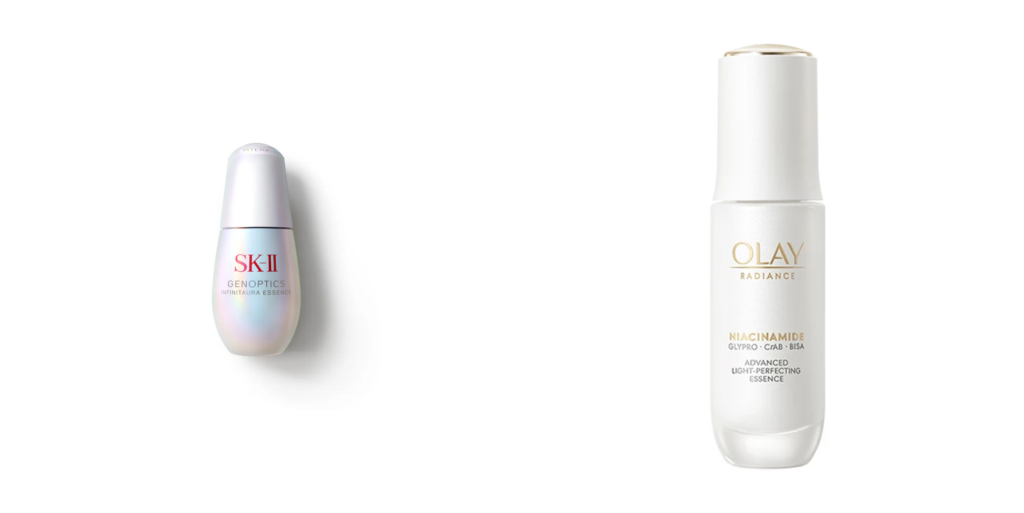
There’s a serum on TikTok right now that people are calling a “US$238 lightbulb in a bottle.” That’s SK-II’s GenOptics Infinitaura Essence, better known by its nickname, the Aura Essence.
And there’s a US$38 bottle sitting quietly on your drugstore shelf that shares its parent company, several of its actives, and honestly, a shocking amount of its ingredient deck.
That would be Olay’s Radiance Advanced Light-Perfecting Essence.
Both are made by Procter & Gamble. Same corporate lab, same “brightening playbook,” wildly different price tags. So I pulled the full CosDNA ingredient breakdowns for both and lined them up. Here’s what’s actually shared, what’s exclusive, and whether your wallet can skip the SK-II counter this year.
The Numbers That Started This Whole Debate
Full-size SK-II GenOptics Infinitaura Essence runs around US$225–US$265 for 50ml depending on where you shop (SK-II runs frequent promos, so watch for those). Olay’s Radiance Advanced Light-Perfecting Essence sits at around US$33–US$38 for 30ml.
Price the bottles straight up and you’re looking at roughly 6x more for SK-II. Even if you adjust for the size difference and compare cost-per-ml, SK-II still runs about 3-4x pricier than Olay, ml for ml. Either way, the gap is real.
Here’s the part that makes this genuinely interesting instead of just “expensive vs. cheap”: P&G owns both brands. That means the formulation teams have access to the same raw ingredient suppliers, the same patented brightening technology, and decades of shared R&D. This isn’t an indie dupe brand reverse-engineering a luxury formula from across the industry. It’s literally the same parent company formulating two different price tiers.
The At-A-Glance Breakdown
| SK-II GenOptics Infinitaura Essence | Olay Radiance Advanced Light-Perfecting Essence | |
|---|---|---|
| Price & Size | ~US$225–US$265 / 50ml | ~US$33–US$38 / 30ml |
| Shared Core Actives | Niacinamide, Undecylenoyl Phenylalanine (Sepiwhite), Xylitol, Bisabolol | Niacinamide, Undecylenoyl Phenylalanine (Sepiwhite), Xylitol, Bisabolol |
| Unique Star Ingredient | Pitera (Galactomyces Ferment Filtrate) + Prunus Mume Fruit Extract | Ascorbyl Glucoside + Nymphaea Alba (White Water Lily) Flower Extract |
| Best For | Dullness + texture + anti-aging, all in one step | Dark spots + brightening on a budget, minimal frills |
The Shared Core: P&G’s Brightening Blueprint
Pull up the ingredient lists and it’s obvious these formulas came out of the same playbook. Both serums lean on Niacinamide as their brightening backbone, a workhorse B3 vitamin that’s about as proven as skincare gets for evening out tone.
Then both bring in Undecylenoyl Phenylalanine, which you might know by its trade name Sepiwhite. This is a melanin-inhibitor, meaning it works upstream to slow down the pigment production that causes dark spots in the first place, rather than just exfoliating existing ones away.
Round it out with Xylitol for hydration and skin-barrier support, plus Bisabolol to calm any irritation from the brightening actives, and you’ve got the exact same functional core in both bottles. This is not a coincidence. This is P&G running one brightening formula through two different price tiers.
SK-II’s Premium Pitera Tax
So what are you actually paying US$200 extra for? One word: Pitera.
It’s the second ingredient on SK-II’s list, right after water, which in skincare terms means it’s dosed generously rather than sprinkled in for the marketing copy. Pitera is a Galactomyces ferment filtrate, essentially a fermented yeast extract that SK-II has built its entire 40-plus-year brand identity around.
This is where the “holistic anti-aging” claims come from. Fermented ingredients like this are associated with skin-barrier support, texture refinement, and an overall balancing effect that goes beyond straightforward brightening. SK-II also tosses in Prunus Mume Fruit Extract (fermented plum) for extra antioxidant backup.
Olay’s formula doesn’t have this. There’s no fermentation filtrate anywhere on its ingredient list. If Pitera’s texture-transforming reputation is the reason you reach for a luxury serum, no amount of niacinamide dupe-matching closes that gap.
Olay’s Value Play: Brightening Without the Frills
Olay isn’t trying to copy Pitera. Instead, it stacks its brightening angle with two additions of its own.
Ascorbyl Glucoside is a stable, gentler derivative of Vitamin C, one that plays nicely with niacinamide without the irritation risk you’d get from pure L-ascorbic acid. It’s a smart budget-formula choice because it’s shelf-stable and doesn’t need the fussy packaging pure Vitamin C requires.
Then there’s Nymphaea Alba Flower Extract, white water lily, added for extra brightening and skin-conditioning support. Combined with the shared niacinamide-and-Sepiwhite base, Olay is delivering a genuinely comparable “fade dark spots, even out tone” experience minus the fermentation-based anti-aging angle SK-II leans on.
The Verdict: Which One Actually Deserves Your Money?
Here’s the honest, no-fluff answer.
Get SK-II if: you want the fermented-yeast, skin-texture-transforming, decades-of-cult-following experience alongside your brightening routine. Pitera is doing things niacinamide alone can’t replicate, and if that’s specifically what you’re chasing, this is the one purchase where the price tag is arguably earned.
Get Olay if: your actual goal is fading dark spots and getting that even, “glass skin” glow using the same Niacinamide + Sepiwhite technology P&G patented for its flagship serum. You’re getting the functional brightening core for a fraction of the price, and putting roughly US$200 back in your pocket.
The real dupe conversation isn’t “is Olay as good as SK-II.” It’s “do you actually need what the extra US$200 is buying you.” For most brightening-focused routines, the answer might surprise you.
Which one’s already in your routine, and are you tempted to switch? Drop it in the comments.
Disclaimer: The information and ingredient analysis provided in this article are for educational and informational purposes only. Everyone’s skin type and condition are different; readers should carefully assess their own individual needs and conduct a patch test before purchasing or using any new skincare. Every product has its unique formulation and characteristics. For specific product inquiries or claims, please contact the respective brand directly. For professional dermatological advice, diagnoses, or skin concerns, always consult a board-certified dermatologist or qualified healthcare professional.