You’ve seen the TikToks. Someone holds up a $95 Lancôme essence next to a drugstore toner and says “same thing, trust me.” Usually, they’re wrong.
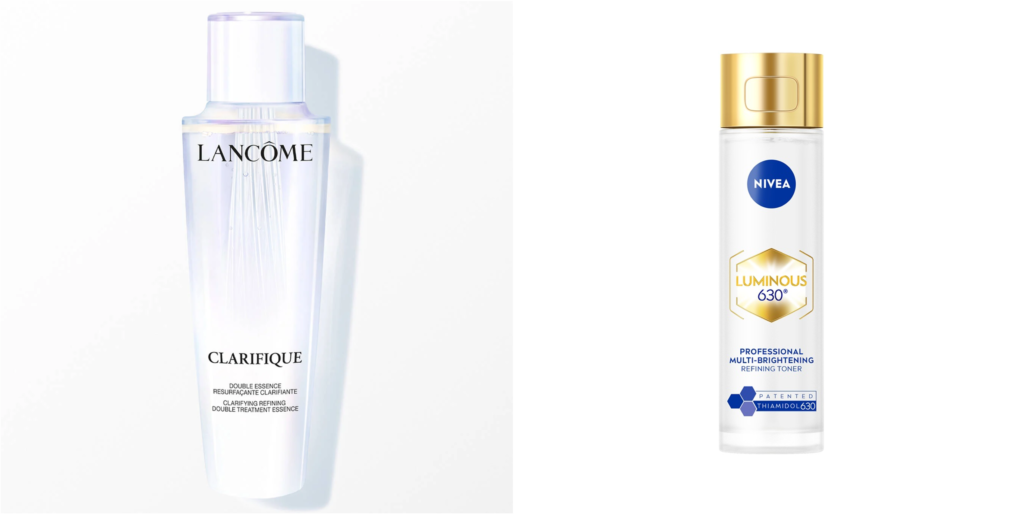
This time? We pulled the actual CosDNA ingredient breakdowns for both products. Let’s see if Nivea’s LUMINOUS 630 toner can really stand next to Lancôme’s Clarifique Double Treatment Essence — acid for acid, brightener for brightener.
The Price Shock
Let’s rip the bandaid off first.
| Lancôme Clarifique Double Treatment Essence | Nivea LUMINOUS 630 Toner | |
|---|---|---|
| Price | ~$95 / 150ml | ~$20 / 120ml (Asia-market release) |
| Price per ml | ~$0.63/ml | ~$0.17/ml |
| You’re paying | ~3.7x more per ml | — |
Quick honesty check: this Nivea LUMINOUS 630 toner is a Taiwan/Asia-market product, so US and UK readers will likely need to grab it through an international retailer or reseller rather than their local drugstore shelf. Doesn’t change the ingredient math — just manage your shipping expectations.
Now let’s find out what that extra $75 is actually buying you.
The Acid Battle: AHA, BHA, and the PHA Nobody’s Talking About
Both formulas lean on exfoliating acids to do the heavy lifting. Here’s the head-to-head:
| Acid Type | Lancôme Clarifique | Nivea LUMINOUS 630 |
|---|---|---|
| AHA (Glycolic Acid) | ✅ Yes | ✅ Yes |
| AHA (Lactic Acid) | ✅ Yes | ❌ No |
| BHA (Salicylic Acid) | ✅ Yes | ✅ Yes |
| Additional acid | Phytic Acid (antioxidant + chelator) | Gluconolactone — a PHA |
Here’s the part that matters if your skin gets reactive: PHAs (polyhydroxy acids) have a bigger molecule size than AHAs, so they exfoliate more slowly and gently, without slipping as deep into the skin. Nivea swapping in Gluconolactone instead of a second AHA is a legitimately smart, sensitive-skin-friendly move — not a downgrade.
Lancôme’s four-acid combo (glycolic, lactic, salicylic, phytic) is more aggressive on paper. Great if your skin can handle it. Less great if you’re already dealing with a compromised barrier.
The Brightening Secrets
This is where the two brands take very different roads to the same “glow” destination.
Lancôme’s hero is French Beech Bud Extract (Fagus Sylvatica Bud Extract) — a pretty extract, but on CosDNA it’s flagged with minimal functional data beyond general skin conditioning. It’s more of a brand story than a proven brightening powerhouse.
Nivea’s brightening squad is stacked:
- Isobutylamido Thiazolyl Resorcinol — this is Nivea’s patented Thiamidol, the ingredient behind the “Luminous 630” name. It works by inhibiting tyrosinase, the enzyme responsible for melanin production. This is dermatologist-recognized tech, not marketing fluff.
- Niacinamide — tone-evening, oil-regulating, and barrier-supporting all in one.
- 3-O-Ethylascorbic Acid — a stable, oil-and-water-soluble vitamin C derivative that won’t oxidize into an orange mess in your bathroom cabinet the way pure L-ascorbic acid does.
Lancôme has one pretty-sounding extract. Nivea has a patented tyrosinase inhibitor plus niacinamide plus a stabilized vitamin C derivative. On paper, that’s not a close fight.
The Sensitivity Check: Fragrance Load
Since we’re correcting the alcohol myth, let’s talk about what actually differs here: fragrance.
- Lancôme carries multiple fragrance-functioning botanicals — Rosa Damascena Flower Oil (rose oil, CosDNA irritancy rating of 3) and Vitis Vinifera (Grape) Peel Extract, both flagged for fragrance function.
- Nivea lists Parfum directly (a formulated fragrance blend) alongside a milder preservative system (Phenoxyethanol + 1,2-Hexanediol).
Neither is fragrance-free, so if you’re fragrance-avoidant, patch test both. But Lancôme’s reliance on essential-oil-derived fragrance (rose oil specifically) tends to be the more common irritant trigger for reactive skin compared to a standard synthetic parfum blend.
Where Nivea pulls ahead on the calming front: Allantoin, a proven soothing and anti-irritant ingredient, plus Sodium Hyaluronate for a hydration boost that Lancôme’s ingredient list doesn’t carry in the same form.
The Verdict: Is Nivea a True Dupe?
Functionally? Yes — and in a couple of ways, it’s arguably the smarter formula.
Choose Nivea LUMINOUS 630 if:
- You want a patented brightening ingredient (Thiamidol) at a fraction of the cost
- Your skin is sensitive or reactive and you want a PHA instead of a second AHA
- You want added hyaluronic acid and allantoin for hydration and calming
Choose Lancôme Clarifique if:
- You want a stronger four-acid exfoliation punch and can tolerate it
- You’re drawn to the sensorial, French-pharmacy experience (fair — sometimes you’re paying for the ritual, not just the ingredients)
- Rose fragrance doesn’t bother your skin
Same acids doing the exfoliating work, arguably better brighteners on the drugstore side, and a $75 difference sitting between them. Which one’s earning a spot in your cart — the patent-backed brightener or the beech bud story?
🛒 Ready to choose? Shop the formulas here:
👉 Shop Lancôme Clarifique Double Treatment Essence (Official US Store)
👉 Shop Nivea LUMINOUS 630 Toner
Disclaimer: The information and ingredient analysis provided in this article are for educational and informational purposes only. Everyone’s skin type and condition are different; readers should carefully assess their own individual needs and conduct a patch test before purchasing or using any new skincare. Every product has its unique formulation and characteristics. For specific product inquiries or claims, please contact the respective brand directly. For professional dermatological advice, diagnoses, or skin concerns, always consult a board-certified dermatologist or qualified healthcare professional.