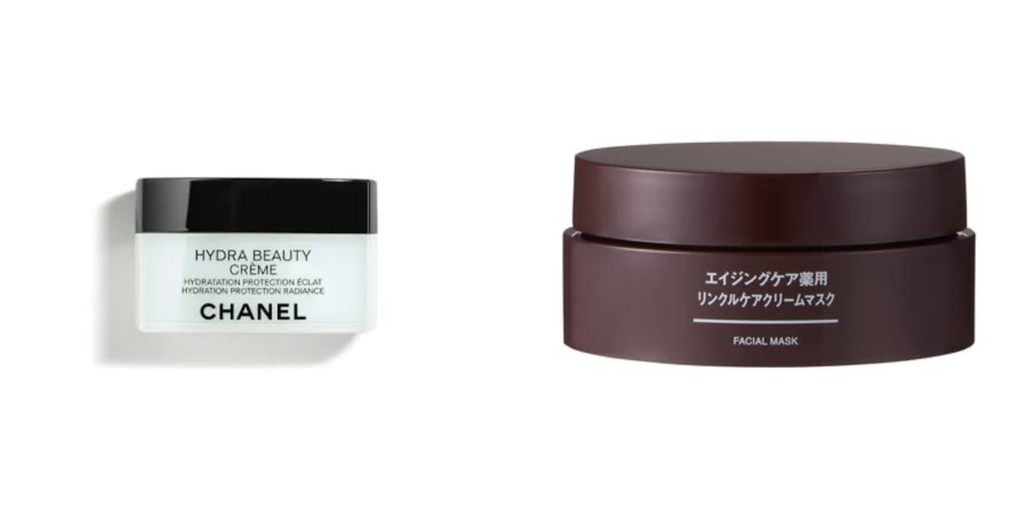
Chanel’s Hydra Beauty Nutrition Cream is the kind of jar that makes a bathroom shelf look expensive. MUJI’s Aging Care Cream is the kind of jar you’d walk past without a second look.
So here’s the uncomfortable question: if you strip away the packaging and just look at what’s actually in the jar, which one is doing more for your skin?
Chanel’s Elegant Barrier
Credit where it’s due: Chanel’s formula is a genuinely lovely piece of textural engineering. It’s built on Shea Butter (Butyrospermum Parkii Butter), Jojoba Esters, and Camellia Kissi Seed Oil, plus Camellia Japonica Flower Extract — a rich, silky moisture barrier designed specifically for dry, “weakened” skin.
Here’s the catch: read the full ingredient list and there’s no vitamin C, no retinoid, no ceramide. What you’re getting is emollient richness and antioxidant support from Vitamin E (Tocopherol) and Sodium Hyaluronate for hydration — genuinely nice, but not what most people mean by “anti-aging actives.” The scent comes from a straightforward Parfum entry, which CosDNA rates at the higher end for irritancy potential.
MUJI’s Hidden Powerhouse Formula
Now flip to MUJI’s ingredient list, and the “no-brand” reputation stops making sense fast.
Ingredient #2 — right after water — is Saccharomyces/Rice Bran Ferment, a fermented active packed with amino acids and skin-conditioning compounds. That’s an unusually high position for a fermentation ingredient in a budget cream.
Then it keeps going:
- Tetrahexyldecyl Ascorbate — a stable, oil-soluble vitamin C ester for antioxidant and brightening support
- Vitamin A Palmitate (Retinyl Palmitate) — worth being precise here: this is a genuine retinoid, but one of the gentlest, weakest forms available. It has to convert twice inside skin before it behaves anything like retinol, so think “retinoid-adjacent support,” not “retinol serum in cream form.”
- Ceramide 3 (Ceramide NP) — a real, barrier-repairing ceramide, something Chanel’s formula doesn’t include at all
On top of that, MUJI layers in a genuinely long list of plant extracts — mulberry root, bitter orange peel, mugwort, rosemary, kelp — that Chanel’s shorter, more streamlined formula doesn’t attempt.
Essential Oils vs. Synthetic Parfum
Here’s a real, verifiable difference: Chanel scents its cream with a single Parfum entry. MUJI instead builds its scent from an actual essential oil blend — Clary Sage, Orange Peel, Camphor Bark, Geranium, Palmarosa, Bergamot Fruit and Leaf, Jojoba, and Mandarin Peel oils are all individually listed, with no generic “Fragrance” entry anywhere on the label. That lines up with MUJI’s own marketing, which states the cream contains no synthetic fragrance.
But here’s the honest caveat, and it’s an important one: “natural” doesn’t automatically mean “gentler.” Several of those individual oils carry meaningfully high CosDNA irritancy ratings of their own — Geranium and Palmarosa oil both rate a 4, Bergamot rates 3–4, and the Mandarin and Orange peel oils range as high as 5–7. That’s comparable to, or in some cases higher than, Chanel’s single synthetic Parfum entry. If you’re fragrance-reactive, a multi-oil essential blend isn’t inherently the safer choice — it may just mean more individual compounds that could trigger a reaction. Patch test regardless of which jar you pick.
One more fun wrinkle: MUJI’s full ingredient list runs to roughly 60 ingredients, nearly double Chanel’s ~34. For a brand built on minimalist, “no-brand” positioning, this is one seriously maximalist formula under the hood.
The Final Verdict
If you’re paying for the double-C logo, a luxe camellia-oil texture, and a genuinely lovely sensory bathroom moment — Chanel delivers exactly that, beautifully.
But if what you actually want is a fermented active, a vitamin C ester, a barrier-repairing ceramide, and a mild retinoid-adjacent ingredient working together for a fraction of the price — MUJI’s formula is doing considerably more active, functional work than its humble packaging suggests.
Chanel wins the vanity shelf. MUJI may be quietly winning your actual skin.
Disclaimer: The information and ingredient analysis provided in this article are for educational and informational purposes only. Everyone’s skin type and condition are different; readers should carefully assess their own individual needs and conduct a patch test before purchasing or using any new skincare. Every product has its unique formulation and characteristics. For specific product inquiries or claims, please contact the respective brand directly. For professional dermatological advice, diagnoses, or skin concerns, always consult a board-certified dermatologist or qualified healthcare professional.