Forget K-Beauty and J-Beauty for a second. There’s a T-Beauty (Taiwanese skincare) secret hiding in plain sight at Watsons drugstores across Taipei, and it goes toe-to-toe with a $150 Armani cult favorite using nearly identical botanical science.
We pulled the INCI lists. The overlap is not subtle.
The T-Beauty Secret
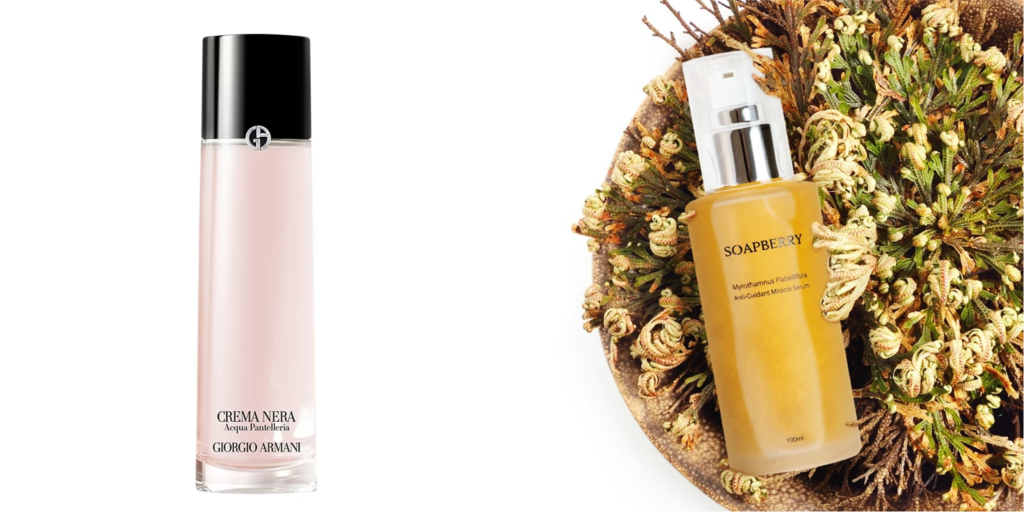
Giorgio Armani’s Crema Nera Acqua Pantelleria Antioxidant Treatment Lotion retails for NT$4,800 (~$150 USD) for 150ml — a fixture of the luxury “resurrection plant” skincare hype cycle. Meanwhile, a Taiwanese drugstore brand called Gu Bao (古寶無患子) sells a Myrothamnus essence at Watsons for NT$450 (~$14 USD) for 100ml.
That’s roughly a 10x price difference — save yourself over $135 — built on a shared hero ingredient most Western shoppers have never heard of.
The “Resurrection Plant” Magic
Armani markets its star ingredient as Reviscentalis™, described in their own marketing as coming from “one of the most powerful resurrection plants” — capable of reviving after years of complete desiccation. Sounds like a $150 secret, right?
Check the actual INCI panel and Reviscentalis™ is officially declared as: Myrothamnus Flabellifolia Leaf Extract. That’s it. A real, legitimately fascinating plant (also called the resurrection bush), just wearing a trademarked name.
Gu Bao’s essence lists Myrothamnus Flabellifolia Leaf/Stem Extract — the same botanical species, extracted from leaf and stem rather than leaf alone. Same resurrection-plant science, doing the same antioxidant and barrier-repair job, at a fraction of the branding markup.
The Hydration Matrix
Both formulas also lean on Tamarind seed for moisture, though in different forms:
- Armani uses Tamarindus Indica Seed Polysaccharide — a more refined, purified form that gives a lighter, faster-absorbing feel.
- Gu Bao uses Tamarindus Indica Seed Gum — a less processed, more film-forming version that leans slightly more toward a moisture-locking finish.
Different textures, same source plant, same core hydration strategy.
The Anti-Aging Overlap
Both serums include Adenosine, a well-studied, sensitive-skin-friendly ingredient that supports smoother-looking skin and is commonly used in serious anti-aging formulas — not just window dressing.
Both formulas also use PEG-40 Hydrogenated Castor Oil, a solubilizer that helps blend oil-based ingredients into a watery texture. It’s not an active, but it’s functionally identical scaffolding in both bottles.
One Point in Gu Bao’s Favor
To be fair in both directions: Armani’s formula includes two synthetic colorants (CI 14700, CI 15985) and a heavier fragrance blend (Linalool, Hexyl Cinnamal, Benzyl Salicylate, plus Fragrance) to achieve its signature pink-tinted, luxury-gel texture. Gu Bao’s version skips the added dyes entirely and uses a single fragrance note (Geranium Oil) — plus it opts for Ascorbic Acid (vitamin C) as an antioxidant rather than Armani’s BHT. If synthetic dyes or heavier fragrance loads are a concern for your skin, Gu Bao’s shorter, simpler list is arguably the safer bet, not just the cheaper one.
The Verdict & Sourcing
Gu Bao is a genuinely smart functional dupe — the resurrection plant extract, the tamarind-based hydration, and the adenosine anti-aging support are all present in both bottles, and the differences that do exist (extract form, colorant load) don’t clearly favor the $150 option.
The catch for Western readers: Gu Bao isn’t sitting on shelves at your local Sephora. You’ll need to hunt it down through Taiwan-focused import sites, Asian beauty marketplaces like YesStyle, or a friend doing a Taipei Watsons run. Given the math — $14 versus $150 for functionally overlapping science — that treasure hunt is worth every minute.
Next time someone tells you luxury skincare secrets are locked behind a designer name, remember: sometimes the resurrection plant is just sitting in a Taiwanese drugstore aisle, waiting for you to read the label.
Disclaimer: The information and ingredient analysis provided in this article are for educational and informational purposes only. Everyone’s skin type and condition are different; readers should carefully assess their own individual needs and conduct a patch test before purchasing or using any new skincare. Every product has its unique formulation and characteristics. For specific product inquiries or claims, please contact the respective brand directly. For professional dermatological advice, diagnoses, or skin concerns, always consult a board-certified dermatologist or qualified healthcare professional.