very few months, a beauty blogger spots two products from the same parent company and slaps “DUPE ALERT” on it without reading a single ingredient. We’re not doing that today.
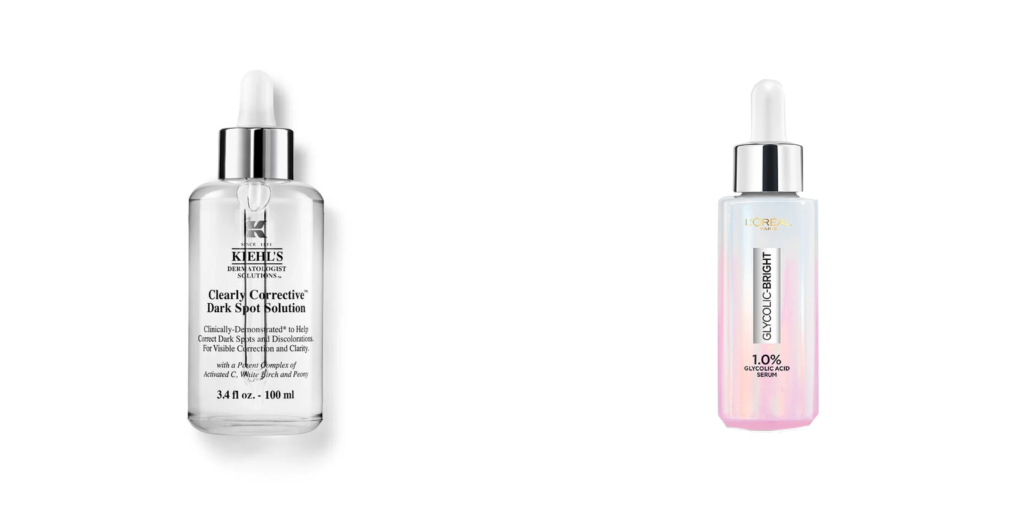
Kiehl’s Clearly Corrective Dark Spot Solution and L’Oréal’s Glycolic Bright 8% MELA Serum are both L’Oréal Group products aimed at the same problem — hyperpigmentation. But they get there through genuinely different chemistry. Same destination, different route. Let’s actually read the map.
The Kiehl’s Approach: Vitamin C + Pro-Xylane
Kiehl’s leans on 3-O-Ethyl Ascorbic Acid, a stable, oil-and-water-soluble vitamin C derivative that won’t oxidize into an unusable orange mess the way pure L-ascorbic acid does. It’s a gentler, slower-acting brightening antioxidant.
Alongside it sits Pro-Xylane (Hydroxypropyl Tetrahydropyrantriol) — L’Oréal Group’s patented molecule for supporting collagen and glycosaminoglycan production, aimed at plumping and firming rather than exfoliating.
One honest addition here: Kiehl’s formula isn’t purely “vitamin C and anti-aging.” It also contains Salicylic Acid at a low 0.45% concentration — a mild BHA. It’s a supporting player, not the main event, but it means this isn’t a fully acid-free formula.
The L’Oréal Approach: Acids + Niacinamide + Melasyl
L’Oréal’s MELA Serum takes a more resurfacing-forward route. Niacinamide sits third on the ingredient list (a strong sign of meaningful concentration), paired with Glycolic Acid for active exfoliation — a more aggressive strategy than Kiehl’s approach.
The headline ingredient is Melasyl (2-Mercaptonicotinoyl Glycine), L’Oréal’s newest patented pigmentation ingredient. Here’s the part worth getting right: Melasyl is not a tyrosinase inhibitor, despite that being the mechanism most dark-spot ingredients use. Peer-reviewed research and L’Oréal’s own published science confirm it works differently — it binds directly to melanin precursor molecules (like dopaquinone) and neutralizes them before they can be converted into visible pigment, intercepting the process a step earlier than traditional brighteners. That’s a genuinely different mode of action, not a marketing rebrand of tyrosinase inhibition.
Worth noting: L’Oréal’s formula also includes Capryloyl Salicylic Acid, a second acid alongside the Glycolic Acid — so this is a formula built around layered exfoliation plus the novel precursor-blocking Melasyl.
The Alcohol Warning
Full transparency: both serums list Alcohol Denat as their 4th ingredient — not just top 5, top 4. That’s a meaningfully high position on an ingredient list, which typically correlates with a higher concentration.
Alcohol Denat is a fast-evaporating solvent that helps active ingredients penetrate and gives serums that “second-skin” dry-down feel — but it can also be drying and irritating for compromised or very dry skin barriers. Neither of these serums is the move if your barrier is already stressed, cracked, or reactive. Patch test both, and consider layering a barrier-supporting moisturizer on top regardless of which one you pick.
The Verdict: Who Should Buy What?
This isn’t a “which one wins” situation — they’re built for different priorities.
Choose Kiehl’s if: you want a gentler brightening approach that pairs a stable vitamin C derivative with anti-aging support from Pro-Xylane, and you’re willing to pay the premium-tier price for it.
Choose L’Oréal if: you want more assertive resurfacing — a real glycolic acid exfoliation dose, a strong niacinamide inclusion, and access to Melasyl, L’Oréal Group’s newest pigmentation-fighting patent — at a drugstore price point.
Same corporate parent, same target concern, genuinely different formulation philosophy. That’s not a dupe story — that’s just two labs solving the same problem two different ways.
Disclaimer: The information and ingredient analysis provided in this article are for educational and informational purposes only. Everyone’s skin type and condition are different; readers should carefully assess their own individual needs and conduct a patch test before purchasing or using any new skincare. Every product has its unique formulation and characteristics. For specific product inquiries or claims, please contact the respective brand directly. For professional dermatological advice, diagnoses, or skin concerns, always consult a board-certified dermatologist or qualified healthcare professional.