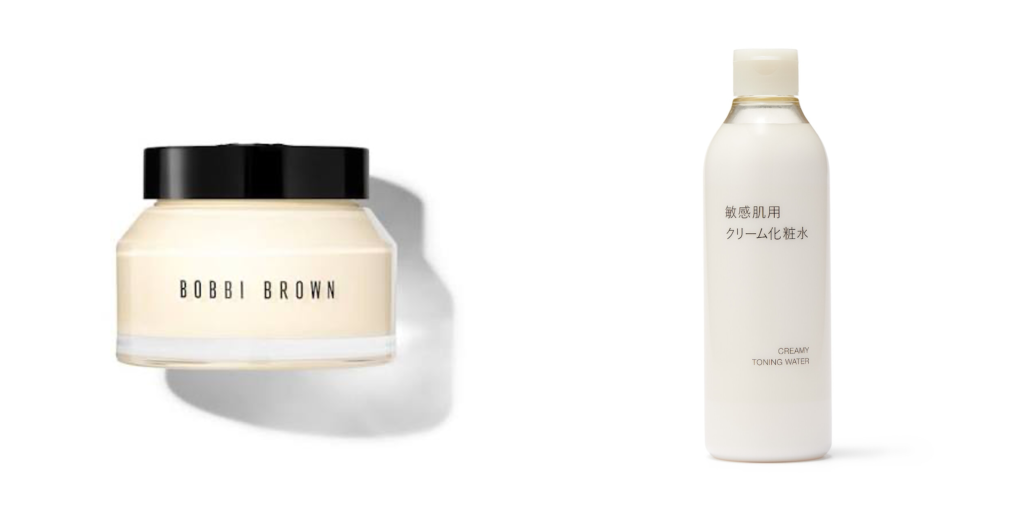
Scroll through enough skincare TikToks and you’ll find this pairing: HK$610 Bobbi Brown Vitamin Enriched Face Base next to HK$65 MUJI Creamy Toning Water, both praised for the same “milky, hydrating” texture.
Here’s the myth we’re squashing today: these are not interchangeable products. They just happen to feel similar on skin. What they’re actually built to do is almost completely different. Let’s break down the labels.
Why People Lump Them Together
Both products have that creamy, lightweight lotion texture that feels good going on and leaves skin looking dewy. That’s genuinely where the resemblance ends. One is a makeup primer disguised as skincare. The other is a bare-bones barrier hydrator built for skin that reacts to everything. Same vibe, completely different job description.
Bobbi Brown: The Makeup Gripper
Bobbi Brown’s Vitamin Enriched Face Base is a primer-moisturizer hybrid, and its ingredient list backs that up. It’s stacked with a genuine vitamin complex: Niacinamide, Dexpanthenol (Pro-Vitamin B5), Ascorbyl Glucoside (a stable vitamin C derivative), and Tocopheryl Acetate (vitamin E). That’s real skin-conditioning support, not just a marketing line.
But the real tell is the texture-engineering. Dimethicone, paired with silicone cross-polymers like Dimethicone Crosspolymer and Methyl Methacrylate Crosspolymer, is what gives this formula its signature soft-focus, pore-blurring finish — the exact quality that makes foundation glide on and grip instead of sliding off by noon. This is a formula designed to sit under makeup, not to be your only skincare step.
MUJI: The Barrier Builder
MUJI’s Creamy Toning Water has a completely different agenda: rebuild and calm, nothing fancy. The formula leans on Ceramide 3 (Ceramide NP) to support the skin’s natural lipid barrier, a full amino acid lineup (Alanine, Arginine, Serine, Proline) to mimic the skin’s Natural Moisturizing Factor, and Dipotassium Glycyrrhizate (licorice root derivative) to calm redness and reactivity.
There’s no foundation-gripping silicone network here, no pore-blurring polymers. It’s a straightforward “hydrate and soothe” formula — which is exactly why it’s marketed for sensitive skin in Japan.
The Sensitivity Warning
This is where the difference really matters for reactive skin. Bobbi Brown’s signature scent comes from real botanical oils: Citrus Grandis Peel Oil (grapefruit peel oil) and Pelargonium Graveolens Flower Oil (geranium oil) — both flagged with meaningfully higher irritation potential on the CosDNA scale. If your skin is prone to redness or breakouts around fragrance, this is a formula to patch-test first.
MUJI is a gentler story, though not a completely blank one. It has no added Parfum and no essential oils — the closest thing to fragrance risk is a small presence of Citrus Grandis Seed Extract, Citrus Paradisi Seed Extract, and Eucalyptus Globulus Leaf Extract, which are plant extracts rather than concentrated essential oils and carry a much lighter fragrance footprint. For most sensitive skin types, that’s a meaningfully safer profile than Bobbi Brown’s — just not a literal zero if you’re someone who reacts even to trace citrus extracts.
The Verdict: Pick Based on the Job, Not the Texture
Buy Bobbi Brown if: you wear makeup daily and want a luxurious, vitamin-loaded primer step that makes your foundation look flawless and last longer.
Buy MUJI if: you have sensitive, reactive, or compromised skin and just want an affordable, no-frills hydrating milk to rebuild your barrier — no makeup agenda required.
Same creamy texture, completely different mission. Don’t let a similar feel on your fingertips fool you into swapping one for the other — check what job you actually need done first.
Disclaimer: The information and ingredient analysis provided in this article are for educational and informational purposes only. Everyone’s skin type and condition are different; readers should carefully assess their own individual needs and conduct a patch test before purchasing or using any new skincare. Every product has its unique formulation and characteristics. For specific product inquiries or claims, please contact the respective brand directly. For professional dermatological advice, diagnoses, or skin concerns, always consult a board-certified dermatologist or qualified healthcare professional.