ime for the biggest price gap we’ve ever put under the microscope: 7.2x. That’s the difference between Lancôme Absolue Light Cream (~$370 for 60ml) and L’Oréal Paris Age Perfect Collagen Royal Light Cream (~$51 for 60ml).
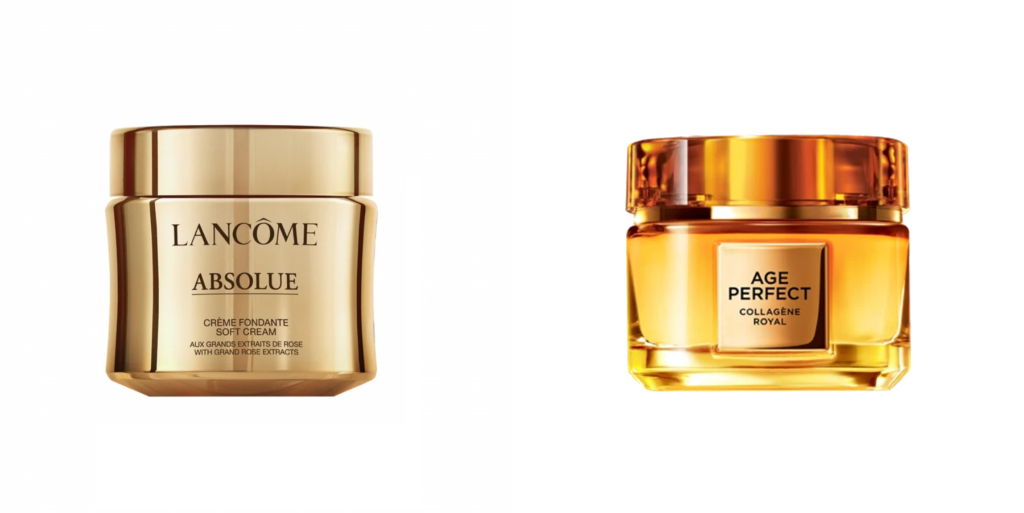
Here’s the part that should make you sit up: L’Oréal owns Lancôme. Same parent company, same chemists, same patented molecule vault. When the group’s flagship anti-aging tech shows up in both formulas, that’s not a coincidence — that’s a corporate family sharing its best ingredient. We ran both full INCI lists to see exactly how much overlap we’re talking about.
The At-a-Glance Breakdown
| Lancôme Absolue Light Cream | L’Oréal Age Perfect Collagen Royal | |
|---|---|---|
| Price & Volume | ~$370 / 60ml | ~$51 / 60ml |
| The Shared Patented Active | Pro-Xylane | Pro-Xylane |
| Unique Star Ingredients | LHA + Salicylic Acid, Rose extracts (Centifolia, Damascena), Meadowfoam Seed Oil | Multi-peptide complex (Palmitoyl Tripeptide-1, Palmitoyl Tetrapeptide-7, Argireline), Honey, Royal Jelly, Collagen |
| Formulation Focus | Plumping + gentle resurfacing, luxury sensorial | Plumping + firming peptides, barrier nourishment |
The Shared Anti-Aging Engine: Pro-Xylane
This is the ingredient that makes the whole comparison legitimate, not just a viral coincidence.
Both creams contain Hydroxypropyl Tetrahydropyrantriol — the L’Oréal Group’s own trademarked molecule, Pro-Xylane. It’s designed to stimulate the skin’s natural glycosaminoglycan production (the stuff that helps skin hold onto structure and bounce), which is the mechanism behind that “plumped overnight” feeling both brands love to advertise.
Both formulas also lean on Vitamin E (Tocopherol in Lancôme, Tocopheryl Acetate in L’Oréal) for antioxidant backup. Same engine, same support ingredient. This is where the “dupe” claim earns its keep.
Lancôme’s Case: Rose, Resurfacing, and a $370 Sensorial Experience
So what exactly are you paying for at the counter?
Lancôme builds its formula on a Meadowfoam Seed Oil base — a lightweight, antioxidant-rich oil that keeps the texture from feeling heavy despite how rich it reads. Layered on top is an genuinely elaborate rose matrix: Rosa Centifolia Flower Extract, Rosa Hybrid Flower Extract, Rosa Damascena Flower Water, and Rosa Damascena Flower Oil, all working together for that soothing, cellular-renewal-adjacent feel the brand is famous for.
The real technical flex, though, is the micro-exfoliation duo: Capryloyl Salicylic Acid (better known as LHA, a gentler cousin of salicylic acid) alongside straight Salicylic Acid. Together they deliver a subtle resurfacing effect on top of the plumping — which is a big part of that “glass skin” polish Lancôme loyalists talk about.
L’Oréal’s Case: A Peptide Army and a Honey Barrier Boost
L’Oréal didn’t just borrow Pro-Xylane and call it a day — they stacked the rest of the formula hard in a different direction.
The peptide lineup here is genuinely dense: Palmitoyl Tripeptide-1, Palmitoyl Tetrapeptide-7, Palmitoyl Tetrapeptide-10, and Acetyl Hexapeptide-8 (the actual INCI name for Argireline, the expression-line-softening peptide). That’s four separate peptides working on firmness and texture, on top of the Pro-Xylane.
Then there’s the nourishment layer: Honey (Mel), Royal Jelly, and Collagen for barrier support and moisture retention. It’s less about polish, more about deep, repeated firming and feeding the skin barrier.
The Verdict: Splurge for Polish, Save for Power
Here’s the honest read after going ingredient-by-ingredient.
Choose Lancôme if: you want a cream that plumps and gently resurfaces in one step, wrapped in an genuinely luxurious rose-scented experience. The LHA/Salicylic Acid combo is doing real exfoliating work you won’t find in the L’Oréal version — that’s a legitimate formulation difference, not just marketing.
Choose L’Oréal if: your main goals are fine lines and barrier nourishment. With four peptides plus honey, royal jelly, and collagen stacked around the same Pro-Xylane base, this $51 jar is arguably more loaded for firming and feeding mature skin than its $370 sibling.
Both are working off the same plumping technology developed by the same lab. The $319 difference buys you rose water and resurfacing acids — not a better core formula. So, are you paying for the polish, or is your skin happier with the peptide power move?
Disclaimer: The information and ingredient analysis provided in this article are for educational and informational purposes only. Everyone’s skin type and condition are different; readers should carefully assess their own individual needs and conduct a patch test before purchasing or using any new skincare. Every product has its unique formulation and characteristics. For specific product inquiries or claims, please contact the respective brand directly. For professional dermatological advice, diagnoses, or skin concerns, always consult a board-certified dermatologist or qualified healthcare professional.